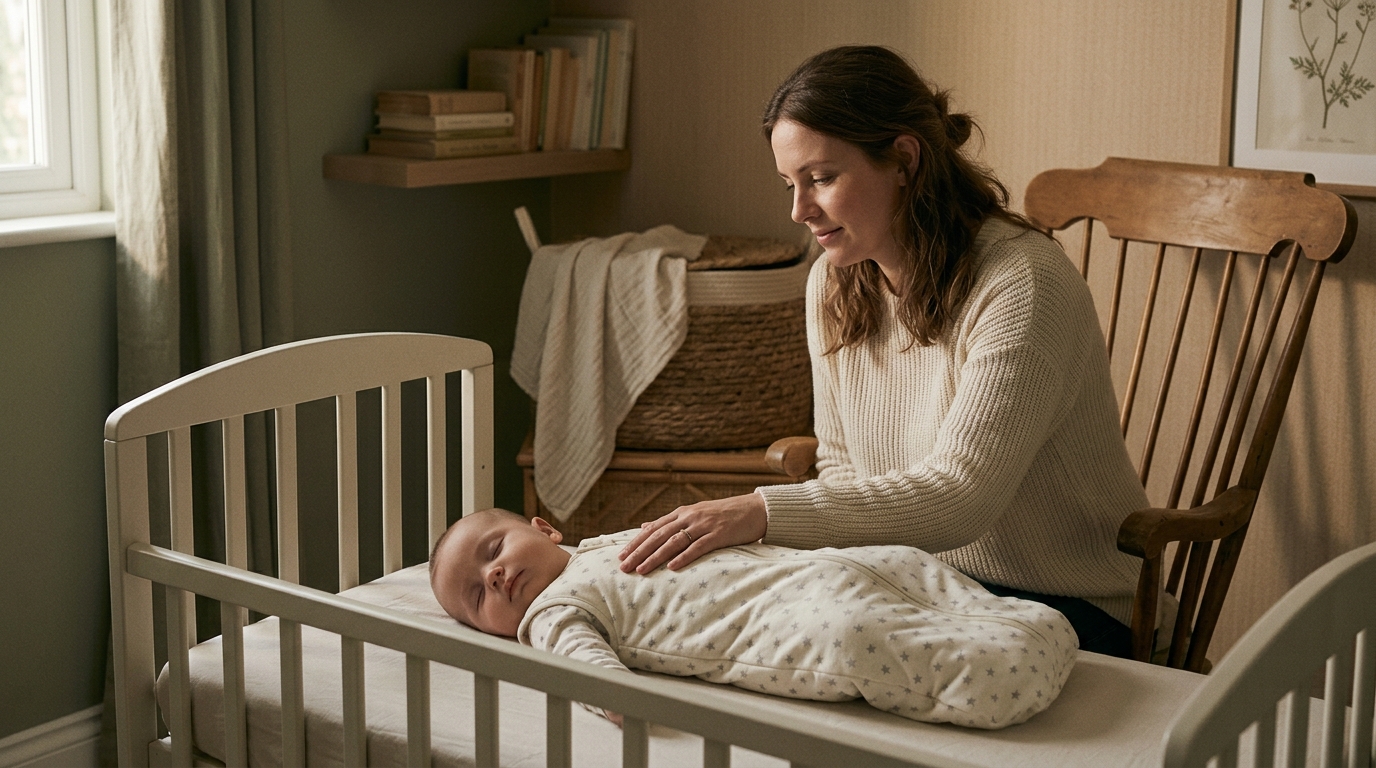
Effective and Compassionate Alternatives to Crying It Out
Alternatives to crying it out include responsive methods like the 'Chair Method,' 'Pick Up, Put Down,' and 'Paced Fading.' These responsive, gentle approaches prioritise parental reassurance and emotional connection. Many families begin to see improvements within 1–2 weeks, with more established sleep habits often developing over 2–4 weeks, all while avoiding leaving a child to cry alone.
For many parents in the UK, the pressure to use extinction methods or 'cry-it-out' (CIO) can feel overwhelming. When you are operating on four hours of broken sleep, the promise of a 'quick fix' is tempting. However, many families prefer to avoid these methods because they don't align with their parenting values or their child's temperament. The good news is that sleep support does not have to be an 'all or nothing' choice between total exhaustion and leaving your baby to cry. There are numerous evidence-based, gentle sleep support strategies that respect the bond between parent and child.
Comparing Popular Alternatives to Crying It Out
If you are looking for a way to improve your family's rest without compromising on responsiveness, it is helpful to compare the leading methods and providers currently available. Each approach offers a different level of parental presence and support.
| Method/Provider | Core Philosophy | Parental Presence | Best For |
|---|---|---|---|
| The Sleep Lady Shuffle (Kim West) | Gradual withdrawal (The Chair Method). | High initially, then gradually reduces. | Toddlers and babies over 6 months who need reassurance. |
| Pick Up, Put Down (Tracy Hogg) | Physical comfort followed by immediate return to the cot. | Very High. Requires physical stamina. | Younger babies (4-8 months) who benefit from frequent reassurance. |
| Nourished Nights (Responsive Support) | Attachment-focused, bespoke plans based on child development. | High and responsive. No crying alone. | Parents seeking a UK-based, OCN-accredited holistic approach. |
| The Possums Program (Dr. Pamela Douglas) | Neuroprotective Developmental Care; following natural cues. | High. Focuses on biological sleep regulation, sensory experiences, and following infant cues. | Families who want to move away from rigid schedules entirely. |
| Lucy Wolfe (Stay-and-Support) | A middle-ground approach with verbal and physical soothing. | High. Parent stays in the room. | Parents who want a clear, structured step-by-step process. |
1. The Chair Method (The Sleep Lady Shuffle)
One of the most well-known alternatives to crying it out is the Chair Method. Developed by Kim West, this approach involves the parent sitting in a chair next to the cot while the baby learns to fall asleep. Unlike extinction methods, you are right there to provide verbal reassurance or a gentle pat if your little one becomes distressed. Over several nights, you move the chair further away from the cot until you are eventually outside the door.
Pros: You never leave your child to cry alone; they can see and hear you throughout the process. Cons: It can be overstimulating for some babies who might get frustrated that you are there but not picking them up.
2. The Pick Up, Put Down Method
Popularised by Tracy Hogg (the 'Baby Whisperer'), this method is a very active alternative. When your baby cries in their cot, you pick them up to soothe them. As soon as they are calm but still awake, you put them back down. If they cry again, you repeat the process. This reinforces the message that 'I am here if you need me, but you are safe to sleep in your cot.'
Pros: Provides immediate physical comfort. Cons: Can be physically demanding for the parent’s back and may take many repetitions (sometimes 50+) in the first few nights. Many parents find this helpful when navigating why a baby cries when put down to sleep.
3. Nourished Nights: Bespoke Responsive Sleep Support
As a responsive sleep consultant, Nourished Nights offers a tailored alternative to the 'one-size-fits-all' books. This approach is rooted in Level 6 OCN-accredited training, sleep science, and child development. Instead of following a rigid method, we look at the whole picture: temperament, feeding, environment, and the parent-child bond. Whether through a Calm Nights Reset or a Restful Family Transformation, the focus remains on never leaving a child to cry alone. This is particularly effective for parents who want a professional to guide them through the nuances of their specific child’s needs.
Pros: Highly personalised, UK-based, and considers the child's emotional wellbeing as the priority. Cons: Requires a commitment to a 2 to 4-week process rather than a '3-day fix.'
4. The Possums Program (Neuroprotective Developmental Care)
This approach focuses less on teaching independent sleep and more on supporting biological sleep regulation, infant cues, and rich daytime sensory experiences. It encourages parents to stop worrying about 'overtiredness' and instead focus on rich sensory input during the day and following the baby's natural cues. It is a fantastic alternative for those who feel that traditional sleep advice is too restrictive.
Pros: Very low pressure; removes the stress of 'naps must be in the cot.' Cons: May not provide enough structure for families who are truly struggling with chronic sleep deprivation.
What are the most effective alternatives to crying it out?
The most effective alternative is always the one that you can implement consistently. Consistency is the cornerstone of any sleep change. Many parents find that responsive sleep methods are more effective in the long term because they don't result in the 'rebound' crying often seen after extinction methods. Many families find that remaining responsive throughout the process feels emotionally sustainable and helps them stay consistent while supporting their child's emotional wellbeing.
Effectiveness is also tied to age-appropriateness. For example, a toddler might respond better to a 'fading' approach where the parent slowly reduces their level of intervention, whereas a 6-month-old might need the immediate physical reassurance of the Pick Up, Put Down method. If you are struggling with a specific age group, such as a toddler waking up screaming, the approach must be even more sensitive to their growing cognitive development and potential separation anxiety.
Is it possible to improve sleep without leaving a baby to cry?
Yes, absolutely. Improving sleep is not synonymous with 'leaving a baby to cry.' Sleep is a biological function, while the ways children settle to sleep and respond to sleep routines develop over time and can be gently supported. You can support your child in learning this skill just as you would support them in learning to walk by being by their side, offering a hand to hold, and slowly stepping back as they gain confidence.
The key to improving sleep without CIO is focusing on the 'sleep pressure' (adenosine) and the 'circadian rhythm.' By ensuring your baby has the right amount of daytime sleep and a consistent, calming bedtime routine, you make the transition to sleep much easier. When biological foundations such as sleep pressure, circadian rhythm, and appropriate routines are well supported, many families find less intensive sleep support is needed. This is why no cry-it-out sleep support focuses so heavily on the 24-hour routine rather than just what happens at 7 PM.
How do responsive sleep methods work in practice?
In practice, responsive methods involve a 'scaffolding' approach. You start with the level of support your baby currently needs to fall asleep (perhaps rocking or feeding) and you slowly transition to a slightly less intensive form of support (perhaps patting in the cot). You respond to your baby's needs while gradually reducing the amount of support over time, helping them build confidence at a pace that suits them. Once they are comfortable with that new level, you move to the next step, such as just having a hand on their chest, then eventually just sitting by the cot.
This process respects the child's communication. If they cry, you respond. You might offer a cuddle, a drink of water (if age-appropriate), or simply a soothing 'shhh.' The goal is not to prevent all crying, crying is a baby's way of expressing frustration or protest at a change in routine, but to ensure they are never alone in that frustration. A baby and child sleep consultant UK can help you identify the difference between a 'protest' cry and a 'distress' cry, which is vital for maintaining a responsive approach.
Creating a Safe and Supportive Sleep Environment
No sleep method will be successful if the environment isn't conducive to rest. In the UK, we follow the guidance of the Lullaby Trust to ensure every sleep is a safe sleep. This includes:
- Placing your baby on their back to sleep.
- Keeping the cot clear of bumpers, toys, and loose bedding.
- Ensuring the room temperature is between 16-20°C.
- Sharing a room with your baby for at least the first six months.
Beyond safety, the environment should be 'sleep-positive.' This means using blackout blinds to support melatonin production and a white noise machine to mask household sounds. If your baby is used to a dummy, ensure you have several in the cot so they (or you) can find one easily in the night.
Managing Expectations and Timelines
When choosing alternatives to crying it out, it is important to be realistic about timelines. Extinction methods are often marketed as '3-day solutions,' but they can be emotionally taxing and may need to be repeated during every illness or tooth. Responsive methods generally take longer, usually between two and four weeks, but the results tend to be more sustainable because they are built on a foundation of trust.
During this transition, you might encounter regressions. This is normal. Sleep is not linear. A child might sleep through the night for a week and then suddenly start waking again due to a developmental leap or a new tooth. A responsive approach allows you to pivot and provide extra support when your child clearly needs it, rather than sticking to a rigid 'rule' that says you cannot enter the room.
FAQ
What is the gentlest alternative to crying it out? Many professionals consider gradual responsive approaches, such as stay-and-support or paced fading, to be among the gentlest options because parents remain available to comfort their child throughout the process. These methods focus on gradual transitions rather than sudden changes.
How long do responsive sleep methods take to work? While every child is different, most families see significant improvements within 10 to 14 days, with the new sleep habits becoming fully established within 3 to 4 weeks. Consistency is the most important factor in this timeline.
Can I still breastfeed and use a responsive sleep method? Yes, responsive sleep support is entirely compatible with breastfeeding. You can continue to nurse your baby to sleep if that works for you, or we can work on gently separating the feed from the act of falling asleep while still maintaining a close, nursing relationship.
Will my baby feel abandoned if I use a sleep method? If you are using a responsive alternative where you remain present and comfort your child when they cry, they will not feel abandoned. You are providing 'co-regulation,' helping them manage their emotions until they are old enough to self-regulate.
Do I need a sleep consultant to do this? While many parents successfully implement these methods using books or guides, a sleep consultant provides the emotional support and objective perspective that is often needed when you are sleep-deprived. They can help you tweak the plan in real-time based on your baby's reactions.
Please note: This article provides general information and is not intended as medical advice. Always consult your GP or health visitor if you have concerns about your child's health, growth, or development.
If you are ready to move away from the 'cry-it-out' pressure and want to find a way to better sleep that feels right for your family, I am here to help. You can download my free sleep guide for immediate tips, or book a free 20-minute discovery call to discuss how we can work together to bring peace back to your nights.